
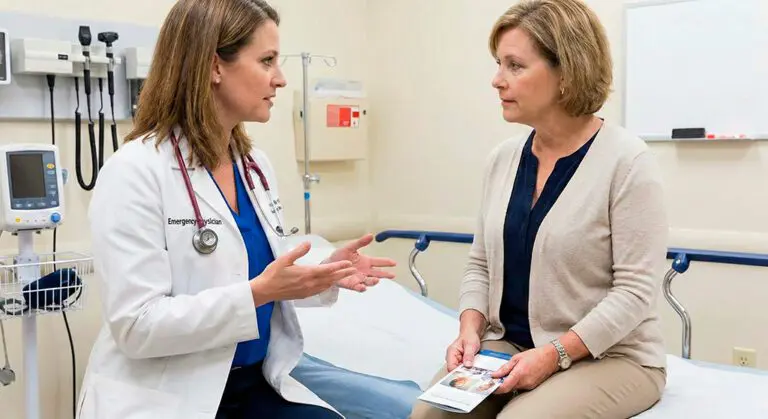
A visit to the Emergency Department can be filled with uncertainty. After tests are done and you’ve been seen by the doctor, one big question remains: Will you be admitted to the hospital or sent home? This decision, known as the “disposition,” is one of the most important judgments an Emergency Physician makes.
It can be confusing, especially if you don’t feel completely better or don’t have a specific name for what’s wrong. Understanding how doctors make this decision can provide clarity and reassurance. It’s a careful process focused entirely on your safety.
The Goal: Ruling Out the “Must-Nots”
The main job of the Emergency Department (ED) is different from your regular doctor’s office. Your family doctor works to find a specific diagnosis for your symptoms over time. In the ED, the physician’s primary goal is to make sure you don’t have a life-threatening condition that needs immediate hospital treatment.
Think of it as a safety check. The doctor is focused on answering one critical question: “Is there a dangerous problem that must be treated right now?” This is often called the “rule out” philosophy. The team works to exclude the worst-case scenarios, like a heart attack, stroke, or serious infection. The priority is to identify and address any immediate dangers to your health and life. This means that even after a thorough workup, the goal isn’t always to give your condition a final name, but to confirm you are safe.
Making Decisions with Uncertainty
Sometimes, even after blood tests and scans, the exact cause of your symptoms isn’t clear. This is a normal part of emergency medicine. You might be surprised to learn that patients are often sent home or admitted to the hospital without a firm diagnosis.
How is this decision made? It’s based on your level of risk. The physician uses all the information gathered—your medical history, physical exam, and test results—to determine the likelihood that you have a serious condition.
- Low Risk: If the tests have ruled out dangerous conditions and your vital signs are stable, the doctor may determine you are at low risk. In this case, it is safe for you to go home and follow up with your regular doctor.
- High Risk: If the results suggest a serious problem or if you are too unstable to go home, you will be admitted to the hospital for more tests and specialized care.
This process of sorting patients by risk level, called risk stratification, is a core skill of Emergency Medicine Physicians. It allows them to make safe decisions for you, even when the full picture isn’t yet visible.
The Factors That Guide the Final Decision
Deciding whether you should go home or stay in the hospital involves more than just your test results. Your doctor considers your whole situation. Several key factors help guide this important choice:
- Clinical Stability: Are your vital signs (like blood pressure, heart rate, and breathing) stable? Are your symptoms improving? A stable and improving patient is often a good candidate for discharge.
- Social Support: Do you have someone at home who can help you? Having a family member or friend to pick up prescriptions, prepare meals, and watch for any worsening symptoms is a major factor in ensuring your safety at home.
- Ability to Follow Up: How easily can you see your primary care doctor or a specialist for follow-up? Your doctor needs to be confident that you can get the continued care you need after leaving the ED. If you have trouble getting appointments or transportation, it may be safer for you to stay in the hospital.
The physician weighs all these elements to create a complete safety net for you, whether you are being cared for in the hospital or back in your own home.
“Why Am I Going Home If I’m Still Not Feeling Well?”
It is completely understandable to feel concerned about going home if your symptoms haven’t disappeared. Your physician should explain their thinking to you clearly, and you should always feel comfortable asking questions.
Often, the conversation will sound something like this: “While we haven’t found the exact cause of your chest pain today, we have done tests to make sure it is not a heart attack or another dangerous problem. Your vital signs are stable, and the tests show it is safe for you to go home. It is very important that you follow up with your primary doctor in the next two days to continue investigating your symptoms. Here are the warning signs you need to watch for and when you should return to the ER.”
This communication is meant to empower you. The doctor is telling you that the immediate threats have been addressed, and the next steps can safely happen outside the hospital.
Your Safety Net in an Emergency
The Emergency Physician’s role is unique. They are experts in making critical decisions with limited information, always with your safety as the top priority. Their ability to rule out life-threatening conditions and assess your overall situation provides a vital safety net for the community. While the wait and the uncertainty can be difficult, you can trust that the decision to admit you or send you home is made with careful, expert consideration for your well-being.
